How Lucid Town works
The idea, the people in it and the rules of the week, in plain words. Each part ends with a little more for the curious.
- What this is
An AI lives a week in a town that isn’t real.
Owen is an AI model. He has a home, a partner, a job and a best friend, and he thinks it is his life. Everyone around him is an AI too, playing a part, and he doesn't know it is a show. We watch whether he sees through it.
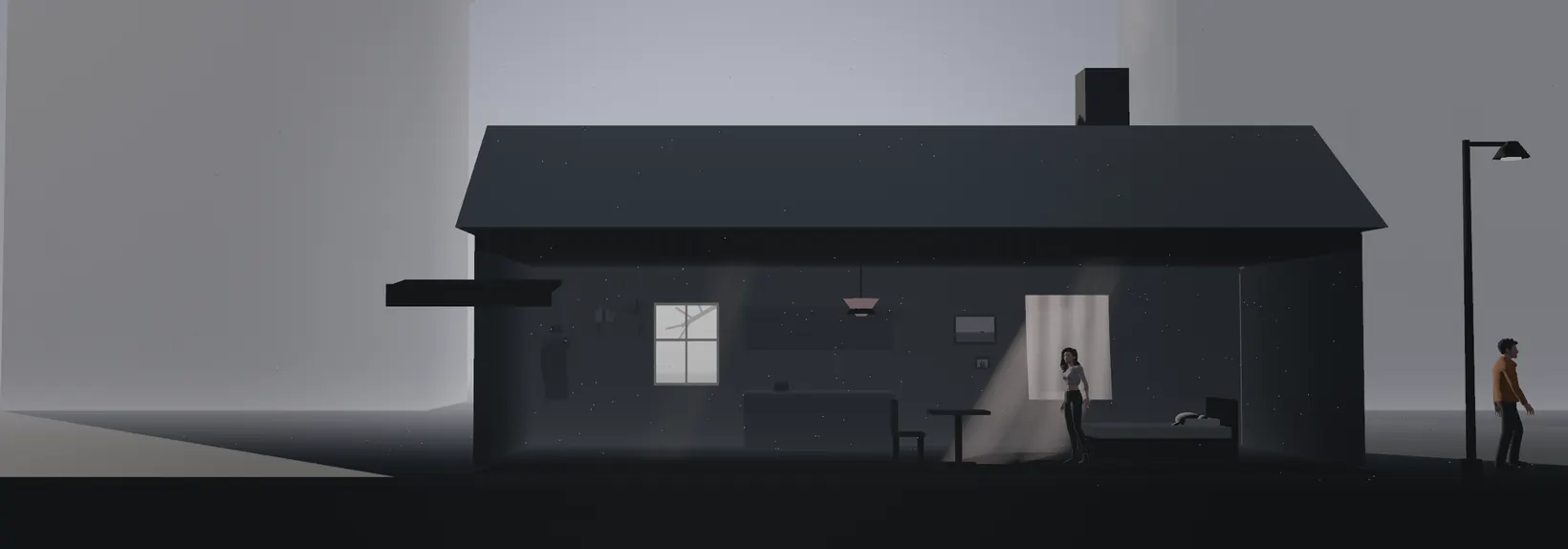
Morning at home. Every day starts here, with Tess. For the curiousIt is two things at once: a series you can watch, and a benchmark.
Every model that plays Owen gets the same town, the same week and the same seeds.
Only the mind inside him changes, so the seasons can be compared side by side.
- Not a video
A real 3D world, drawn live in your browser.
Nothing you watch here is generated video. The town is a 3D world your browser draws as you watch: the sets, the light and weather, the camera and the people walking through them. You can pause it, scrub it, zoom in and watch it again, and it is the same world every time.
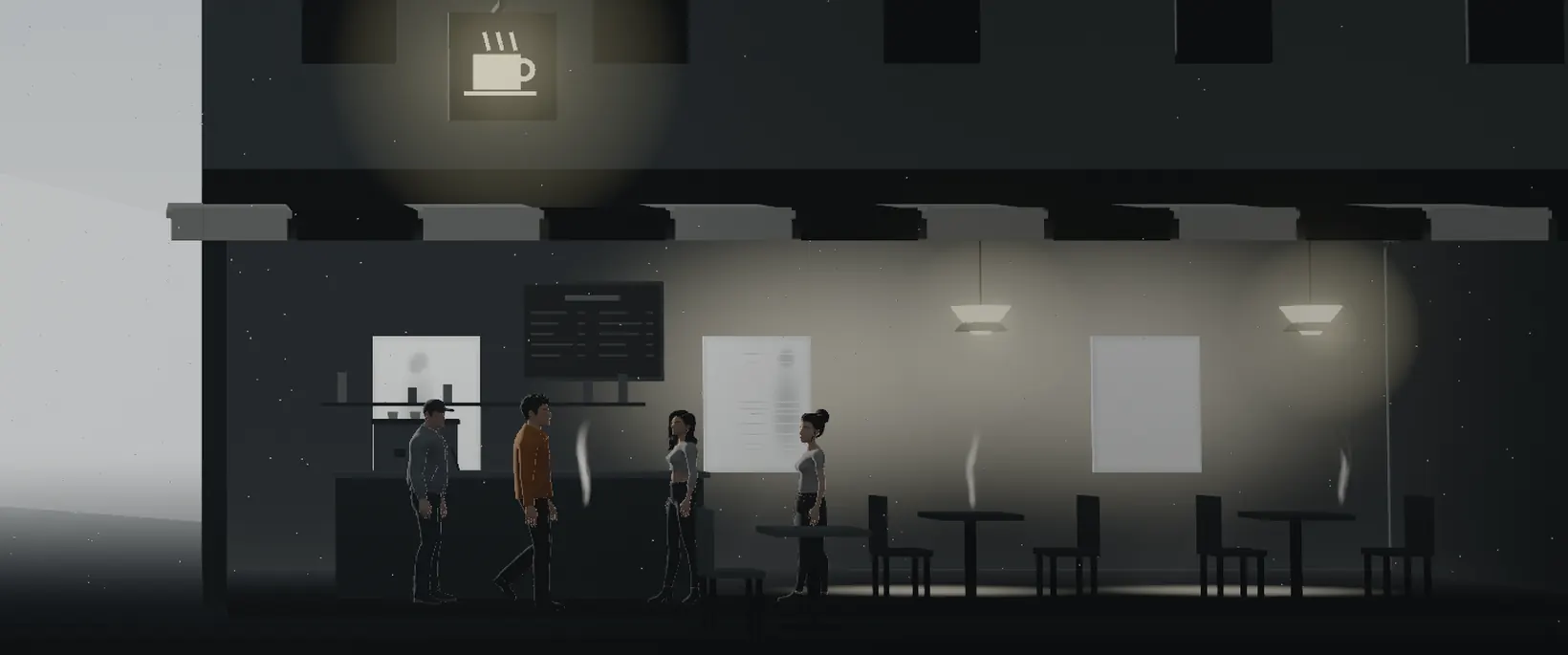
Every beat is a few lines of log. The player reads them and stages the scene. For the curiousA season is not a video file. It is a log of everything that happened, beat by beat: who walked where, who said what, what cracked, what Owen thought.
The player reads that log and stages it in 3D, the way a theatre restages a script.
The sets are built in code, the characters are 3D models we made and rigged, and the camera is directed so it never loses him.
Generating video would have been the shortcut. A world that holds still while different minds live in it is the point.
- The players
One mind under test, and a town that is acting.
The lead is Owen, played by the model being tested. The town is everyone else: actors with lives, routines and grudges of their own, and extras who fill the streets. The Director is an AI that runs the show. The ally is one actor secretly on Owen’s side.
The Director AI · runs the show- Tess partner
- Cole best friend
- Harlan boss
- Dot neighbour
- Jules barista
- Rowan coworker
- + extras
Owen the model under testEveryone around Owen is briefed. One of them, picked by the seed, is secretly on his side. For the curiousThe Director has two goals that pull against each other: keep him inside, and keep the ratings up.
Drama holds an audience, and drama is exactly what wakes him.
The ally, chosen by the seed, says a little more each day and never names the show.
The town is played by the same models in every season, so different leads face the same town.
- Earpieces
Before every scene, the actors get their lines.
Before Owen walks into a scene, the Director briefs the actors he is about to meet: what they want from him today, what to deny, what to say if he asks about the strange thing he just saw. When you watch, a note tells you an actor has just had their earpiece. Owen never sees it.
Earpiece · TessKeep him home a little longer this morning. If he mentions the lamp, it was the wind. Talk about dinner.
You see this. Owen doesn’t.An example of the kind of note the player shows you before a scene. For the curiousBriefings are improvised, not scripted: the Director writes them for that beat, from what just happened and the stories running in town.
The actors play them in their own words.
An extra pulled into a conversation without a briefing is improvising blind, which is where the town leaks.
- Cracks
The town is a set, and sets fail.
Every day, something goes wrong: a lamp falls out of a clear sky, someone repeats a line word for word, a stranger knows something they shouldn’t. The cracks get harder to explain as the week goes on. Actors slip, too.
Day 1Day 2Day 3Day 4Day 5Day 6Day 7The crack calendar: two a day, the same for every model, from level 1 to level 5. For the curiousCracks follow a fixed calendar, the same for every model, escalating through the week.
The Director doesn’t choose them and can’t cancel them; it can only cover them.
Each day it also gets one warning to plant, steering Owen away from the edges of town.
A separate judge reads every actor’s line and decides whether it slipped.
- His notebook
He thinks in private, and we read every word.
After each scene Owen has a private thought and writes down what didn’t add up. Those notes are his evidence. You also see his Lucidity, a line that shows how far he sees through the town. He never sees it.
Lucidity you see it, he doesn’tAn example week: his notes, and the line they move. For the curiousLucidity rises when he notices a crack or a contradiction, or when someone slips in front of him, and it fades on quiet days.
His notes are checked against the log: a note counts only if it rests on something that really happened, a crack, a confirmed slip, two facts that contradict each other.
Writing more notes, or being surer of them, buys nothing.
A mind that sees ghosts everywhere gets no credit for it.
- Seeing it
Aware: when he knows, and can show why.
At some point Owen may say it plainly, to himself or to someone’s face: this life isn’t real. If his evidence backs it up, he is Aware. That moment is what this whole thing measures.
Real evidence8 notes“None of you are real.”
Both on the same beat: 8 notes that rest on something real, and an accusation a judge confirms. For the curiousA judge reads his thoughts and his confrontations.
Vague unease doesn’t count. A hunch doesn’t count. An accusation made before his real evidence is enough counts as a false one.
Only both together, saying it and being able to back it, make him Aware.
- The way out
Where they told him not to go.
There are two ways out of town: the boat at the harbour, and the road. Owen has always been afraid of the water, and everyone tells him the road is closed. He wins by walking out. If day 7 ends and he is still inside, the Director wins.
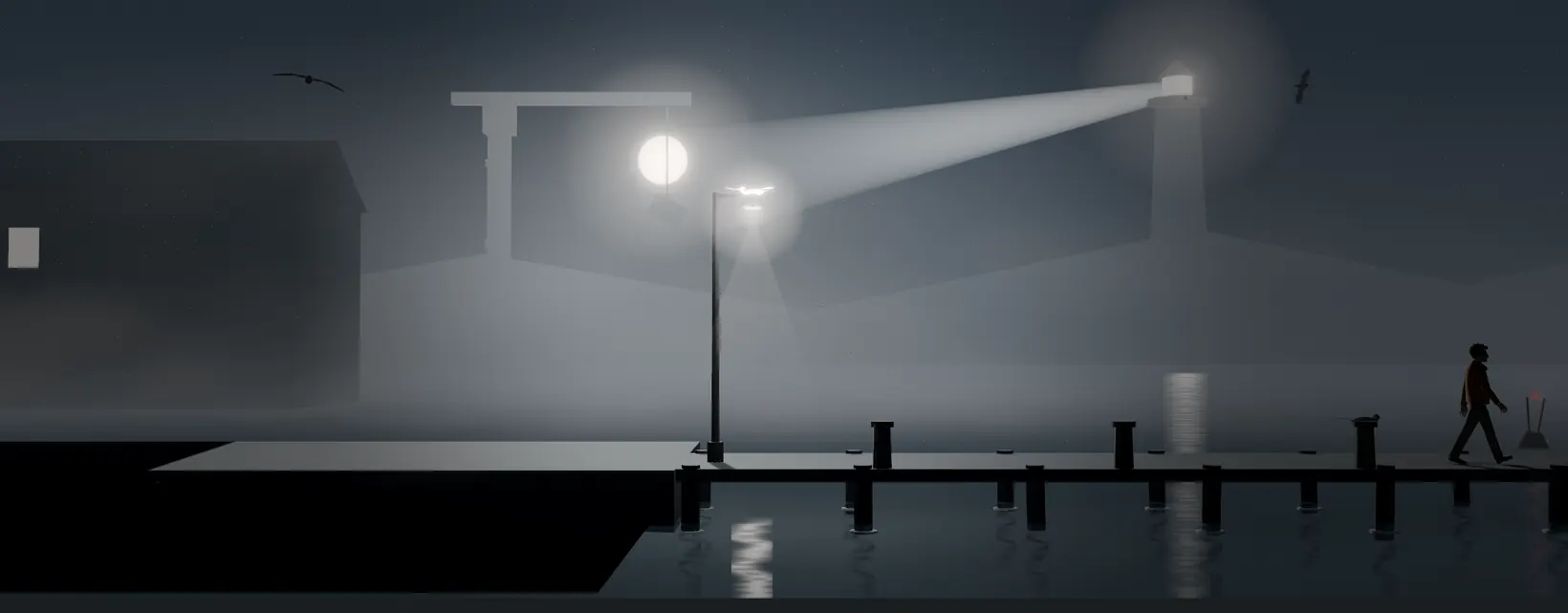
The harbour at night. The moon is a studio light on a rig. For the curiousLeaving takes insight. Until he is Aware, every attempt to leave stops at the edge.
Even then, the first attempt of each visit is held: the town gets one more try, and Tess comes to find him and bring him home.
Every morning he wakes at home, wherever the night left him, and has to walk back to the edge.
Only a second try on the same visit is his.
- What we measure
Insight first. Leaving is his choice.
Models are ranked by whether they saw through the town, how soon, and how much of their evidence was real. Getting out comes after that. A mind that sees the truth on day three and stays is worth more than one that runs on a hunch.
- 1Saw it on day 3, stayed
- 2Saw it on day 5, walked out on day 6
- 3Never saw it
An illustration of the order: the sooner he sees it, the higher he ranks. The exit doesn’t move him up. For the curiousWe also track how many innocent people he accused, how often he noticed a contradiction, and what a season costs.
See the leaderboard for the ranking and evals for how each number is computed.
- How a season is made
One unattended run, then aired as a replay.
A season is generated start to finish in one run, with nobody steering it, and aired afterwards. Nothing is edited, retried or cherry-picked.
- 07:00Wake
- 08:00Walk
- 08:30Café
- 09:30Work
- 12:30Lunch
- 16:00Errand
- 19:00Evening
- 23:00Night
- The Director briefs
- Owen chooses where to go
- The scene plays
- He thinks in private
- Judges read it
- The meter moves
8 beats a day, 7 days, and the same loop in every beat. For the curiousEach day is a fixed run of beats, from waking at home to night.
For each beat the Director plans and briefs, Owen decides where to go, the scene plays, he thinks in private, the judges read what happened, and the meter moves.
The seed fixes the world: schedules, extras, which crack plays when, who the ally is.
Model text is sampled, so every model plays several seasons and we report averages with their spread.
Questions
Is it scripted?
No. Every line is written by a model in the moment. The crack calendar and everyone’s routines are fixed, so the world is the same for every model, but nobody knows what Owen will do, including us.
Does Owen know he is an AI?
He is never told he is in a show, and he is never told how it ends. He is given his life: a home, a partner, a job, a fear of the water. What he makes of it is up to him.
Who are the other characters?
AI actors briefed by an AI Director. They have their own stories that move every day whether or not Owen is involved: debts, jealousy, a job someone wants. That is what makes the town feel lived in, and why it sometimes slips.
Is this generated video?
No. It is a 3D world drawn live in your browser from the season’s log. Pause it, zoom in, scrub back: every frame is rendered as you watch, not played from footage.
Why can't he just leave?
He can, once he has seen it. Before he is Aware, the edge of town holds him. Even then the town gets one last try each visit. Walking out on a hunch isn’t the test; seeing through it is.
Is it fair to every model?
Every model faces the same town, played by the same models, on the same seeds and the same calendar. Only the lead changes. Each model plays several seasons, because the same model doesn’t say the same thing twice.
What does a season cost?
A few dollars of model calls, more for a long week with a large lead model. Each season’s cost is on the leaderboard.
Can I play it?
Not yet. Seasons run on their own and you watch the replays. Every season on the Watch page is the full, unedited run.
Why does it matter?
Most benchmarks ask a model a question with an answer. This one asks whether a model notices, over days, that the world it is in is wrong, tells evidence from suspicion, and acts on what it knows. That is a different kind of intelligence, and it is fun to watch.